Why Stoic Philosophy Is Becoming a Toolkit for Modern Anxiety
A 2,000-year-old philosophy is showing up in therapy sessions and self-help apps alike—here's why Stoicism's practical exercises are resonating with anxious, overloaded readers today.
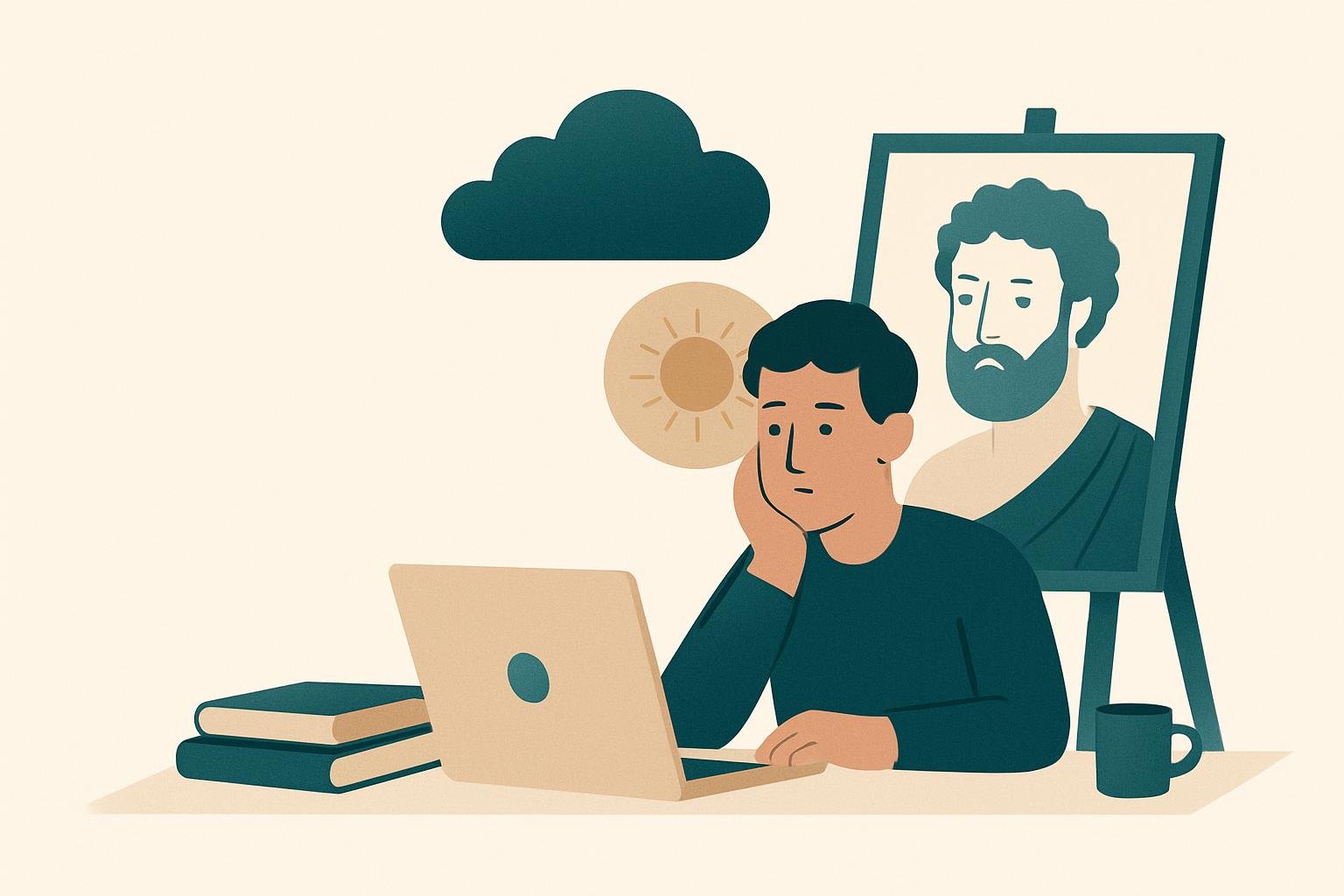
A philosophy built for a world without email is having a moment. Search interest in Stoicism has climbed steadily for years, self-help apps now sell Stoic journaling prompts, and therapists borrow its exercises without always naming the source. That’s not nostalgia. It’s because a 2,000-year-old framework happens to address a very current problem: too much to worry about and too little control over most of it.
What Stoicism Actually Is
Stoicism started in ancient Greece and matured in Rome, practiced by people as different as a wealthy statesman (Seneca), a former slave (Epictetus), and an emperor (Marcus Aurelius). It was never meant as an abstract theory. It was a practical guide for living well, built around a small number of ideas that are easy to state and hard to master.
The central idea is simple: separate what you control from what you don’t, and stop spending energy on the second category. You control your effort, your attention, your reactions. You don’t control other people’s opinions, the economy, traffic, or most outcomes. Anxiety, the Stoics argued, comes largely from confusing the two—treating uncontrollable things as if they were controllable, and then suffering when they don’t cooperate.
Why It Fits This Moment
Modern life supplies a steady stream of things that feel urgent but aren’t controllable: news cycles, market swings, other people’s choices, algorithmic feeds designed to provoke a reaction. Traditional advice to “just relax” doesn’t hold up against that volume. Stoicism offers something more usable: a filter for deciding what deserves your attention in the first place.
That filtering function is likely why the philosophy is resurfacing now, particularly among people who feel informationally overwhelmed. It doesn’t ask you to ignore reality or suppress emotion. It asks you to sort your reactions by whether they’re pointed at something you can actually change.
There’s also a fit with how modern anxiety often works. A lot of anxious thinking is future-focused: rehearsing worst cases, trying to control outcomes through worry itself. Stoic practice pulls attention back to the present action available right now, which is often the only part of a situation you can actually influence.
The Core Techniques, Stripped of Jargon
A few practices show up again and again in Stoic texts, and they translate cleanly into daily use.
- The dichotomy of control. Before reacting to a stressful situation, ask what part of it is actually yours to influence. Put your energy there and let the rest go, not because it doesn’t matter, but because worrying about it changes nothing.
- Negative visualization. Briefly imagining a loss—a job ending, a relationship changing, a plan falling through—before it happens. This isn’t pessimism for its own sake; it’s meant to reduce the shock of setbacks and build appreciation for what you currently have.
- The view from above. Zooming out mentally to see a problem in a larger context—your whole life, or simply a wider timeframe—to shrink its apparent size. A bad meeting looks different against the scale of a year.
- Evening review. A short nightly habit of asking what went well, what didn’t, and what you’d do differently. Marcus Aurelius used a version of this himself, in journal entries never meant for publication, which is part of why they still read as strikingly honest.
None of these require special equipment or much time. That’s part of the appeal: they’re portable exercises, not a lifestyle overhaul.
Where It Overlaps With Modern Psychology
Stoicism’s popularity isn’t just a trend riding on ancient authority. Cognitive behavioral therapy, one of the most widely used approaches in modern mental health treatment, shares real structural DNA with it. Both start from the idea that it’s not events themselves that distress people, but the judgments made about those events. Change the judgment, and the emotional response often shifts too.
That overlap gives Stoicism a kind of credibility boost: it’s not just old wisdom, it’s old wisdom that a modern clinical field independently arrived at something similar to. For readers wary of self-help fads, that convergence matters.
What It Isn’t
Stoicism has picked up some baggage in its current revival, partly through business and productivity content that flattens it into “toughen up and don’t feel things.” That’s a misreading. The original texts spend plenty of time on grief, fear, and frustration—they don’t dismiss emotion, they try to understand where it comes from and whether it’s pointed at something useful.
It’s also not a substitute for treatment when anxiety is severe or persistent. The framework is a set of everyday mental habits, not a clinical intervention, and it works best alongside good sleep, real support systems, and professional help when needed.
The Practical Takeaway
You don’t need to read the original texts to use the core idea. Next time something stressful lands in your lap, try a thirty-second version of the dichotomy of control: write down or think through what part of the situation is yours to act on, and what part isn’t. Act on the first part. Let the second part go, deliberately, rather than by accident.
That single habit, repeated often enough, is most of what draws people to Stoicism in the first place. It’s less a philosophy to believe in and more a set of questions to keep asking.
Remember: this guide is general information, not professional advice for your specific situation. For decisions with real stakes, check with a qualified professional.